


With the completion of this module, the participant should be able to/ or have done:
- Understand the sales process.
- Know how to obtain information from clients.
- Understand the skill of listening.
- Know how to ask questions and how to listen.
- Know how to write a personal profile.
- Know how to put together a pre-listing kit.
Remember to get your workbook out and follow through in it, as you complete the lessons online. Don't forget to complete your daily planner, as well as record your notes and questions about the lessons, which you can post in the Facebook group.
The Sales Process
The sales process is illustrated using a pyramid. 11 is divided into five levels, which represent the five stages in the process These stages have a pre·determined order and each one builds on the ones before ii In order to get to the last stage, you must complete, in the correct order, all the stages that go before it.
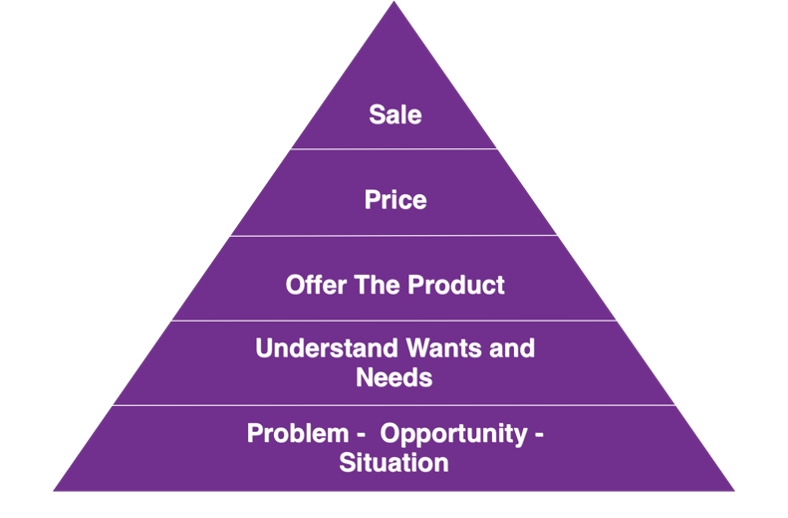
The first stage in the sales process deals with the vendor's circumstances and is called "Problem-Opportunity-Situation"
People do not buy or sell on a whim Their reasons for selling fall into one of three categories problem, opportunity or situation.
The first category is where the vendor is forced to sell but may not want to, such as where a couple is divorcing and must sell as part of a court settlement
The second category is where the home no longer suits the owner's circumstances or lifestyle
The third category is where the vendor sells up to enable them to take advantage of an opportunity
The second stage of the sales process is Wants and Needs.
It's above "Problem-Opportunity-Situation" because wants and needs usually arise from the vendor's circumstances
For example, if the vendor is moving to take up a job elsewhere in two weeks, they'll probably need the house to be sold quickly.
The third stage of the sales process is the product
This product is determined directly by the vendor's wants and needs. We know that the vendor's fundamental need or want is to sell the home; on that basis, then, the product is the services and marketing programme you provide to achieve that goal.
The fourth stage in the sales process is the price.
Remember the old selling rule Product Before The Price? The price must come after the product. lf it doesn't, it can be an obstacle to, rather than an ingredient of, the sale For vendors, the price of your services and marketing programmes has little relevance until they know exactly what you're offering_ What does it matter what ii costs, if they don't know what they're buying?
The last stage in the sales process is the sale itself-
Of the property, or of your services to the vendor This stage looks after itself, as the sale is the natural result of all that has gone before. The process starts at the base of the pyramid and completion of each stage supports the stage above. If you have done the work involved in the first four stages, the sale will be waiting for you at the top.
The fact is that every size opportunity begins with a situation, opportunity or a problem.
SITUATION
The situation is our home is too small or our home is too big.
OPPORTUNITY
The opportunity is for us to get a job in Melbourne and we need to sell our house to do it.
PROBLEM
We don't have enough bedrooms; we are in financial difficulty. The reality is you will sell it the way that you WANT.
The difference between a want and a need is that you need to sell your home because of a problem but will sell it the way that you want.
It is wants that make the world go around not needs and we all buy what we want not what we need.
In terms of listing, it’s the same issues.
The questions ascertain the wants.
You introduce the product by way of a presentation that matches their wants.
The selling fees come at the end after you have introduced the product.
A listing is taken very easily if you keep this sequence.
Obtaining Information
The Skill of Listening
Knowledge and skills taught in this session.
• About the skill of listening
• How to ask questions and how to listen.
The skill of listening
The other skill you will use to obtain information from clients is listening. Listening is not hearing - it is paying attention to what you hear. Contrary to what people assume, it is a learned skill that takes effort and concentration.
The main reason why listening is difficult is that the average person talks at about 125 words a minute but can process other people's speech at about 400 words a minute. So, if they don't make the effort to maintain attention. their mind tends to wander in the 'gap'. This gap between speaking and processing speech is the biggest obstacle to attentive listening.
Here are some general tips for improving your listening:
• Know in advance what information you need and what questions to ask so that you can concentrate fully on what is being said rather than on what you are going to say.
• Concentrate on what is being said with your whole body. Lean forward mentally and physically.
• Keep an open mind and never assume you know what the person is going to say.
• Ask them to clarify anything that you do not fully understand.
• Periodically, sum up what has been said and ask for confirmation.
• Take notes.
Exercise:
In this exercise, you will practise asking questions and listening.
You will need to find a partner for this exercise. Hold a conversation with your partner by onty asking questions. Each of you answers the other's questions but can continue the conversation only by asking another question. The conversation can be on any subject but it must flow. The person asking the questions will have control of the conversation. If your partner steals control by answering a question with a question, you will have to regain control by asking another question. You will also have to listen very carefully to their replies in order to formulate the next question and keep the conversation flowing. Practise using the question cushions as you go.