

With the completion of this module, the participant should·
• Understand why accurate pricing is critical to selling a house.
• Understand the three time periods involved in selling a house.
• Know how to calculate the market value of a house.
• Know how to set an asking price.
• Know how to answer common vendor objections.
Realistic Pricing
Session Outcome:
Why realistic pricing is the most critical factor in whether a house will sell.
Realistic pricing
Price is the most critical factor in whether a house will sell. Arguably, it carries 90 percent of the weight. So getting it right is crucial, for the vendor and for you.
Look at it this way. If someone offered to sell you a $50 note for $100, would you take it? The answer is obvious; the note isn't worth $100.
But what about $30? Would you buy it for that? Of course you would. Again, you know the value of the note, and know it's a bargain at $30.
The key point is that the value of the note is known to you and everyone else. The person selling the note can't dream up any figure and expect to sell it for that.
The same principle applies to houses on the market. The price of a house is determined not by the vendor, but by the market. It doesn't matter what reasons the vendor might have for wanting a particular amount for the house. None of them will determine the price of the house. The price will be determined solely by factors of the market, which are outside the vendor's control.
When people want to buy a house, the first thing they do is school up on the property market. The average buyer looks at between 14 to 20 homes before buying. By looking around, they quickly work out what those houses in their price bracket are worth. If a vendor asks an unrealistic price for their home, buyers will not be fooled. They know exactly what a particular property in their price range is worth.
It is therefore crucial that a vendor asks a realistic price for their house. Getting it right first time can save thousands of dollars and months of time.
It is your job to show the vendor what the market is suggesting their home is worth. You do this by explaining the market they are selling in and logically applying simple pricing principles. This means you need to understand the market and the principles thoroughly, because you will have to be clear and convincing in your explanations.
The Selling Timeframe
Session Outcome:
The timeframes and selling periods involved in selling a house
Selling timeframes: Timeframes for the three types of market
The time it takes to sell a home depends on the type of market you are operating in. The forces of supply and demand can either stretch that time out or make it very quick. Each type of market has an average number of days in which homes are sold. These figures are represented in the following table:

The three selling periods
Within these timeframes, there are three distinct ·selling periods'.
The diagram below represents the three periods and the proportion of sales in each.
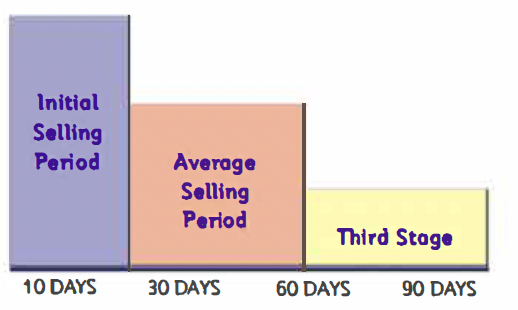
The first selling period is called the initial selling period. In a seller's "Market, it may be only a matter of hours. But in a buyer's market and balanced market, it is usually seven to 10 days after the listing.
The second selling period is called the average selling period. It begins after the initial selling period and runs up to the average time it takes to sell in your market.
The third selling period is called the third stage and ends when the hJuse is sold. This period has some dangers and you should do what you can to avoid it.
Calculating the Market Value
Session Outcome:
How to calculate the market value of a house, and the principle that cost does not equal value.
The market value
The market value is exactly that: the value that is set by the market. II is calculated using the principle of comparison: by comparing the home you are pricing with other homes like it that have recently sold in the area.
There is a rule in prope,ty valuation that you must bear in mind when valuing a home. The rule states that cost does not equal value. This means that the vendor's costs are not linked to the value of the home.
This principle also applies to the cost of maintaining the home.
Another thing vendors cannot do is expect the value of their home to increase simply because they are buying or building a more expensive one. This is obvious if you look at the principle in another context.
The examples above show that people can strongly resist accepting the market value of their home. For all sorts of reasons, they will have strong emotional ties to their home, which will incline them to unrealistically inflate its value. Your job is to distance yourself from the pricing process and get the vendor to see that the issue of price is really between themselves and the market.
Setting the Asking Price
Session Outcome:
How to use the list/sale price difference in setting the asking price.
The Asking Price
In order to set an asking price, you need to know the average gap between the price that vendors have been asking for their homes and the price they have been getting for them. It is given as a percentage. This percentage is a guide to how much the asking price can exceed the market value.
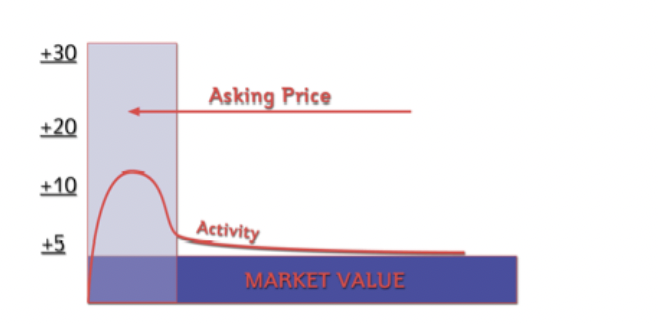
If you look at the diagram, you will see that the curve indicating sales goes to its highest point during the initial selling period, when houses are most likely both to sell and to fetch the best price. If the vendor puts the house on the market at too high a price, such as the one represented here. they will completely miss the benefits of that selling period.
Vendors argue that if they set a price close to the market value, they will lose money. But this isn't the case. They never had that money in the first place. The percentage gap tells you what the market will pay; it was never going to pay more. The vendor will just lose lime and money by not using the initial selling period to their advantage.
Role Play
You will need to find a partner for this exercise.
You will role play answering the vendor's objections to asking price.
One person will play the consultant and the other, the vendor.
The purpose of the exercise is to give you practice in answering a vendor's objections and explaining how pricing works.
The person playing the vendor must raise the following objections:
• Ours is worth more than that one.
• We paid that for it nearly ten months ago.
• We need this amount to build/buy elsewhere
• We've spent $25,000 on improvements.
• Why can't we try higher for a while - test the market?
• Lost Realty said this much and Chumps Real Estate this much.
• But this is below the registered valuation.
• We are in no hurry. We'll just sit and wait until we get a higher price.
• Won't they make us an offer if we are too high?
The consultant must try to answer the objections
Where appropriate, use diagrams.
Pricing Strategy
Session Outcome:
The strategy for the conducting the pricing section of the presentation.
Pricing strategy
We have already learned that pricing is the most critical factor in selling a home. However, for reasons too numerous to count, the price the vendor expects is often considerably above the market value. We call this price the emotional price.
Here is the strategy for conducting the pricing section of the presentation. Between the opening and closing direction statements, it has six steps
Step 1: Opening statement
Begin by explaining to the vendor that you will arrive at a market value through comparisons with similar properties, and reminding them of how you like to work: that is, you'd like to go through the comparisons together, to see what the market is saying their home is worth. You don't want to just throw statistics at them. Ninety nine percent of the time, they will be fine with that
Step 2: Go through each comparison in the Cma
Bring out your Cma with the properties listed, and ask them "Tell me, do you know any of these homes?" Go slowly through each home that they know and have them compare it with their own home. If they say their home is better, don't disagree. Remain impartial and supportive, and ask why.
This is the point where the vendor begins to work through the logic of the situation
The objective is to let them use the facts to come up with a logical figure themselves.
Once you have covered the homes they know, you can introduce the others on the list Explain that you have visited them and believe they make good comparisons. At this point, the vendor may express real concern. They may say, "Are you telling us that's what our home is worth?" Explain that these are comparable homes but you are yet to take into account the differences between them and the vendor's. If they continue to object, ask them to withhold judgement until you have gone through all the comparisons.
Step 3: Handling objections
At this point, you are likely to hear the objections and you need to be able to respond immediately when you do.
Step 4: Ask the vendor what they think the market value is
When you have thrashed out the comparisons, ask them where they think their home lies on the market. If they suggest this is your job, do not give a price. Go back to the comparisons and suggest which ones look the best It is important the vendor realises that the figure is based on the market, not your opinion. Ask the vendor again what value they think the market is suggesting.
If the figure is too high, go back to the comparisons. Keep reminding the vendor that any objection they have is with the market, not with you. If they continue to have trouble accepting the comparisons, offer to take them in the car to look at the homes. The key is to get them to see for themselves where their home fits on the market
If the figure is reasonable, move on to step 5.
Step 5: Explain how to set an asking price
Remind them of the narrow gap between list prices and sale prices and point out that, in light of that, it is important to keep as close to the agreed value as possible. Ask them what they would like to do.
Again, the vendor may raise the objections. It is very important that you can answer them confidently and easily so that you don't get derailed. Once you have answered the objections, it is time to move on to a price range and then a list figure
Step 6: Set a price range and a list figure
Set the price range, then the list figure. A price range is needed because it gives you and the vendor some flexibility if the market or circumstances change and a price adjustment is necessary later on.
There are two situations where this flexibility is important. The first is where a house is hard to price, such as where there aren't enough good comparisons to use.
The second is where the vendor is well motivated but is stretching the price a little beyond where you think it should be. In both these cases, you need a wider range than usual.
One thing always stays the same: the bottom of the range has to be at, or just below, the market value you and the vendor have come up with. So, the bottom line is the least that the house ought to sell for and you adjust the top according to circumstances and what the house may fetch.
Closing statement
It's important that there's a finish to this section. When they're ready to move on, the vendor will go what I call 'mindful'. They've got all the information and they're working it through. You should close with something reassuring, like: "I want you to remember that I'm here to get you the highest price the market will pay. If the market's there, we'll get it!"
Demo of the Pricing Strategy
Session Outcome:
A demonstration on how to conduct the pricing section of the presentation.
Opening statement
Mr and Mrs Wilson, we've found that the best market indicators of price come from homes that have sold recently and are in some way comparable to yours. So, I've gone out looking for these and have here the best comparisons I can find. But before we go through them, can I just remind you again of how I like to work. I know I've said this before, but I really do want to work with you, not at you. So, I'd like for us to go through them together and find out what you think they mean for the market value of your home. I don't want to just chuck figures at you. Is that Ok with you?
Step one
Tell me, do you know any of these homes?
Yes, this one
Think about it for a minute ... How do you feel it compares with yours?
Well, ours is nicer
Can you tell me why you say that, Mrs Wilson?
Because it's ...
Yes, that's true, and yours is a love y home. But we'd also need to take into account that this house has a larger section, and a double garage. Let's put this one aside for a minute, and come back to it when we've looked at the others on the list
Are you saying you think that's what our house is worth?
No, I'm not saying that. I'm saying that we can use this house, and the others on the list, as a guide. Your house probably is worth more than this one, but work there are lots of other factors to comparing consider- both with the 2 houses I've mentioned and the others on the list. So, I'd ask you to withhold judgement. We can work through the lists together, comparing the houses and making necessary adjustments for differences. Then you can decide for yourselves how your house fits into the picture. Does that make sense?
Step two
Having looked at all these homes, where do you think your home fits Into the picture?
What do you think? This is what you should be good at.
Well, it's not a question of what I think, but of what the market thinks. That's where the 'market' value of your home comes from. We've agreed that these two houses are the most comparable homes on the list, and that's where the answer must lie. This one sold for $223,000, and the other for S215,000.
I'm still not happy with those comparisons. I still think our house is worth more than that.
Mrs Wilson, we need to see your home the way the market sees it. Those two homes are the most comparable to yours, and those prices are what the market paid. Now, your home does seem to be worth more than this one; it has a much better kitchen, and the state of the roof there did take the price down a little, I think. So you're not at the bottom of that range. But look at this other one. ls your home any better overall? If you don't think so, there's no reason to think the market will see it differently. If you like, I can take you for a better look at these homes, and any others on the list you want to see, so you can see why I chose them and compare them for yourselves.
Step three
We think the market value is pretty close to the value of this house and that, or perhaps just below it, should be our bottom line. It's a case of how much above that market value you can try for. I do have some fairly firm ideas about that Remember I showed you earlier the difference between list prices and sale prices? Because that difference is so slim, it's important we keep as close to our agreed market value as possible. What would you like to do?
Step four
The words in step four will be determined by individual circumstances.
Closing statement
Remember, I'm here to get you the best possible price the market will pay. That's my job, and with your help, we're going to do that
Role play: 1
In this exercise, you will role play the market and pricing sections of the presentation
The scene: The vendor's home. The consultant has been around earlier in the afternoon and inspected the property. They have asked all the pertinent questions about the vendor's situation, and are now ready to proceed with a presentation.
The consultant: Give a presentation to the vendor. Cover the first two sections, on the market and pricing
The vendor: You are motivated to sell. You have some objections about price, but allow the consultant to proceed if they answer your objections.
Refer to the list of objections below, as often as necessary.
- Ours is worth more than that one
- We paid that for it nearly ten months ago
- We need this amount to build orbuy elsewhere
- We've spent $25,000 on improvements.
- Why can't we try higher for a while - test the market?
- United said this much and Professionals this much.
- But this is below the registered valuation
- We are in no hurry. We'll just sit and wait until we get a higher price
- Won't they make us an offer if we are too high?